Shopify Development Services for High-Performance E-commerce Stores
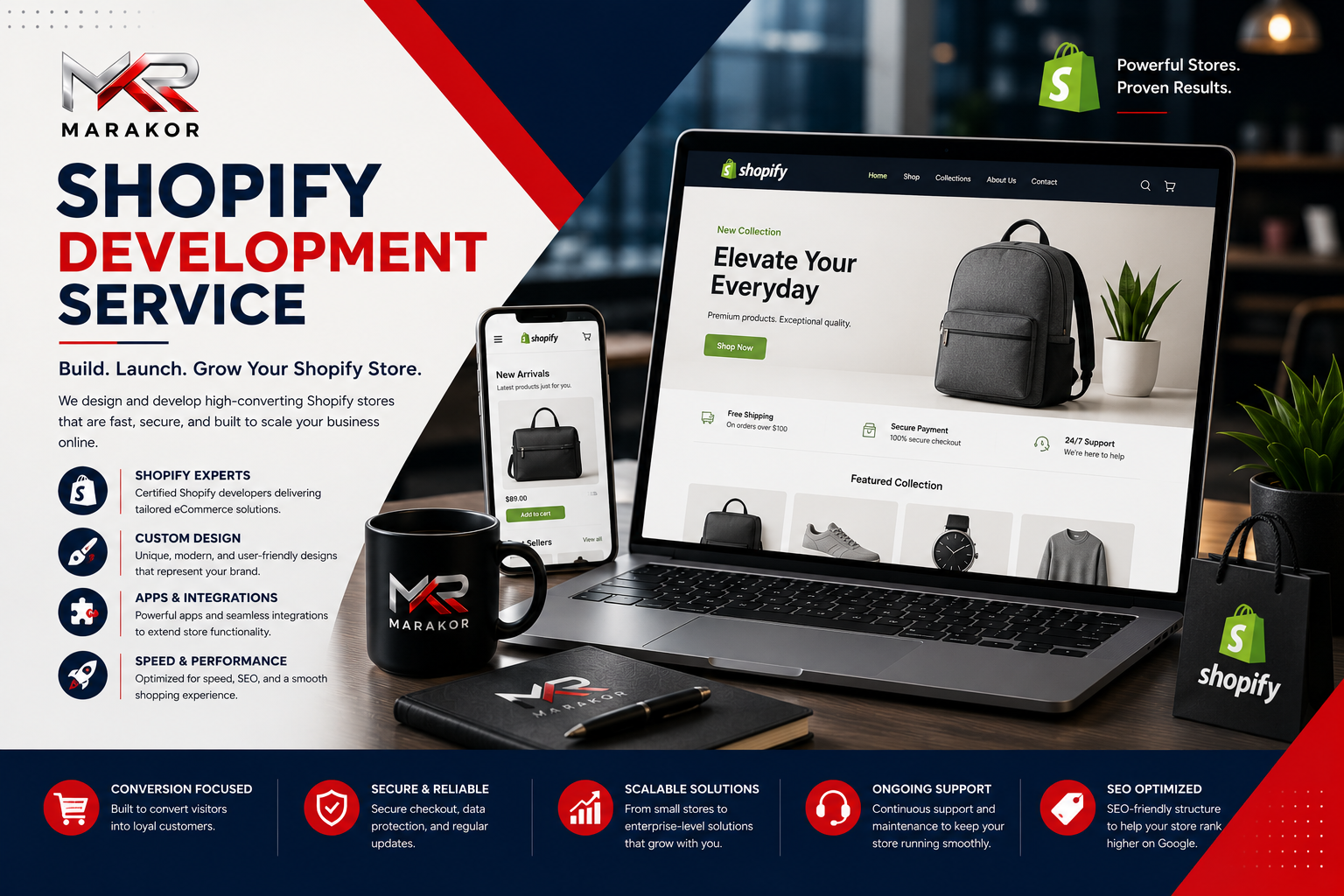
A Shopify store is more than a theme and a checkout button. It’s a system of decisions — how products are presented, how customers navigate, how fast pages load, how search engines find you, and how easily someone goes from browsing to buying. MARAKOR builds and refines Shopify stores around all of these pieces at once, combining e-commerce strategy, UX/UI design, development, performance, and SEO-aware implementation into one process.
Whether you’re launching a new store, customizing an existing theme, migrating from another platform, or scaling into more advanced Shopify functionality, MARAKOR approaches each project as a business system, not just a storefront.
Professional Shopify Development Services
MARAKOR is a remote software house working with startups, DTC brands, retail businesses, and established companies across the United States, United Kingdom, Canada, Australia, the UAE, and Europe. Our Shopify work sits alongside our broader development, design, and SEO services — which means your store isn’t built in isolation. It’s built with the same strategic thinking we apply to UI/UX design, performance optimization, and search visibility.
We don’t treat every project the same way. Some stores need a fully custom theme. Others need thoughtful customization of an existing one. Some need a careful migration with SEO preserved. Our job is to figure out which approach actually serves your business, and build accordingly.
What Is Shopify Development?
Shopify is a hosted e-commerce platform that lets businesses build, manage, and operate online stores without maintaining their own server infrastructure. It handles the underlying technical foundation — hosting, checkout, payment processing infrastructure, and platform security — while giving store owners tools to manage products, content, and design.
Shopify development is the work of turning that foundation into a store that actually fits a specific business. Depending on the project, that can include:
The right combination of these depends entirely on the project — a new DTC brand and an established retailer migrating their catalog need very different things.
Our Shopify Development Services
Mobile-First Shopify Development
The majority of e-commerce browsing now happens on mobile devices, which means mobile experience isn’t a secondary consideration — it’s often the primary one. We build with attention to mobile navigation, touch-friendly controls, image handling on smaller screens, readable typography, sticky elements where they genuinely help (like add-to-cart actions), and a cart experience that doesn’t require excessive scrolling or tapping. Page performance on mobile networks factors into these decisions as well, since a beautifully designed page that loads slowly on mobile data undermines the experience it was meant to create.
Shopify SEO
Shopify gives stores a reasonably SEO-friendly foundation out of the box, but that foundation alone doesn’t guarantee visibility. Our approach to Shopify SEO covers:
Rankings ultimately depend on more than technical setup — content quality, competition, domain authority, and ongoing search algorithm behavior all play a role. We build the technical and structural foundation properly; we don’t promise specific ranking positions, guaranteed traffic, or guaranteed indexing.
Shopify Performance Optimization
Store speed affects both user experience and search visibility, so performance is treated as a core part of development rather than an afterthought. We focus on:
- Optimized, appropriately sized images
- Efficient, uncluttered theme code
- Reducing unnecessary or redundant scripts
- Evaluating third-party app impact on load times
- Lazy loading where it improves real-world performance
- Efficient section and component structure
It’s worth being direct here: Shopify performance is influenced by more than theme code alone. Apps, third-party scripts, the volume and type of content on a page, and Shopify’s own infrastructure all play a role. We won’t promise a perfect PageSpeed score, guaranteed Core Web Vitals thresholds, a specific load time, or a guaranteed conversion improvement — those depend on variables outside any developer’s full control.
Conversion-Focused E-commerce Development
Store structure can support conversion without any single element guaranteeing it. Our approach centers on:
Clear Product Information
Helping customers understand exactly what they’re buying before they commit.
Strong Product Imagery
Presenting products in a way that reduces uncertainty.
Simple Navigation
Helping customers find what they’re looking for without unnecessary steps.
Trust Elements
Where appropriate, incorporating reviews, clear policies, contact information, and shipping/returns details.
Clear Calls to Action
Reducing ambiguity at decision points.
Friction Reduction
Removing unnecessary steps between interest and purchase.
We won’t quote specific conversion percentages — legitimate conversion outcomes depend on your product, market, pricing, and traffic quality, not just store structure.
Our Shopify Development Process
Understanding your brand, products, customers, existing store (if any), competitors, and business goals.
Defining store structure, navigation logic, product organization, and where conversion opportunities exist.
Where included, developing wireframes, page layouts, and responsive component design.
Building out theme, sections, templates, product structures, and core functionality.
Configuring products, collections, images, navigation, and page content.
Connecting required third-party apps and external systems.
Checking mobile and desktop behavior, navigation, product pages, cart, forms, search, integrations, links, and browser compatibility.
Reviewing metadata, URL structure, structured data, image optimization, and mobile experience.
Going live according to the agreed project plan.
Where included in the project scope, providing continued maintenance and optimization. Support scope is defined per project rather than open-ended.
Shopify vs WooCommerce
Both platforms are capable e-commerce solutions, and the right choice depends on your business rather than a universal “better” option.
| Factor | Shopify | WooCommerce |
|---|---|---|
| Hosting | Fully hosted and managed by Shopify | Requires WordPress hosting, managed by you or your provider |
| Setup | Simplified, e-commerce-focused environment | Greater flexibility, more setup involved |
| Customization | App ecosystem plus theme/code customization | Extensive customization through WordPress’s open ecosystem |
| Control | Managed infrastructure, less server-level control | Greater control over hosting and configuration |
| Best fit | Businesses wanting a managed, e-commerce-dedicated platform | Businesses already on WordPress or needing deep infrastructure control |
If your business is weighing WordPress-based e-commerce, our WordPress Development service covers WooCommerce builds in more depth.
Shopify vs Custom E-commerce Development
Shopify suits businesses that want a faster path to launch, managed infrastructure, and an established e-commerce toolset without building everything from the ground up. Custom e-commerce development becomes relevant when a business has highly specialized workflows, unique business logic, or needs extensive control over system architecture that a platform like Shopify isn’t designed around.
Neither option is inherently superior — Shopify handles genuinely complex stores well, and custom development isn’t automatically the “more serious” choice. It comes down to what your operation actually requires.
Why Choose MARAKOR?
What You Receive
Depending on the agreed project scope, deliverables may include:
Not every deliverable applies to every project — scope is defined per engagement.
Industries We Serve
MARAKOR’s Shopify development supports businesses across fashion, beauty, food & beverage, consumer products, home & lifestyle, electronics, health & wellness products, sports & fitness products, accessories, and general retail. (For health and wellness products specifically, store content is built to present products clearly without making medical claims.)
Build Your Shopify Store With MARAKOR
A Shopify store that actually performs — for customers and for your business — needs more than a theme installed out of the box. It needs strategy behind the structure, design behind the experience, and technical care behind the performance and SEO.
MARAKOR brings e-commerce strategy, UX/UI design, Shopify development, performance work, and SEO-aware implementation together into one process, built around how your customers actually shop and what your business actually needs.