SEO Services Built for Sustainable Organic Growth
Professional SEO Services for Modern Businesses
Search is still where most buying decisions begin. Before a customer calls, fills out a form, or adds something to a cart, they usually search for it first — and if a business isn’t visible, technically sound, and relevant at that moment, the opportunity is gone before it starts.
MARAKOR provides SEO services built around search intent, technical quality, content relevance, and long-term visibility — not shortcuts or ranking promises. As a software house that also builds and maintains websites, we approach SEO with a rare advantage: we understand what’s happening under the hood, not just what shows up in a report.
Our SEO work supports startups, e-commerce brands, SaaS companies, professional service businesses, and growing organizations across the US, UK, Canada, Australia, UAE, and Europe who want organic growth that compounds rather than fades when a campaign stops.
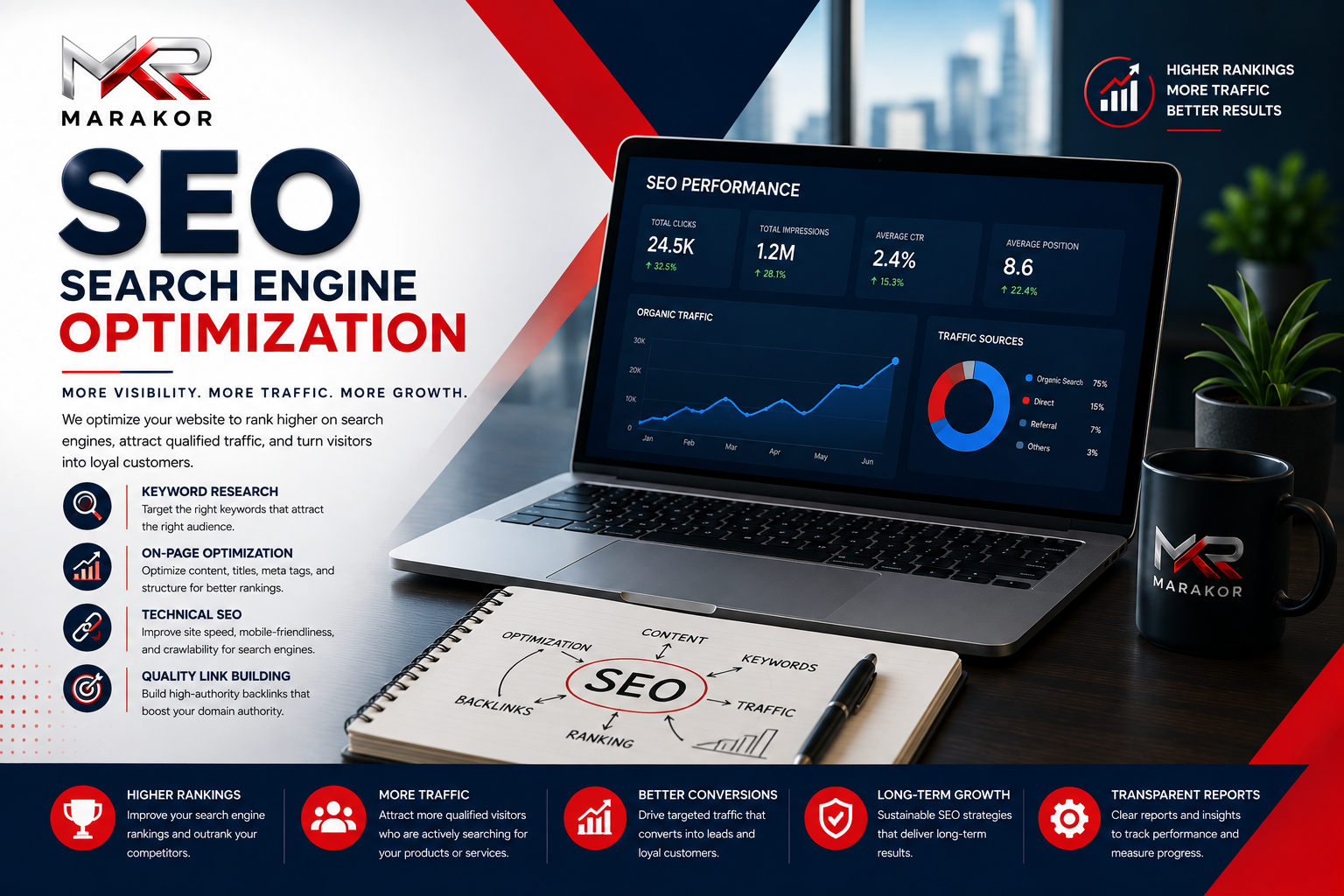
What Is SEO?
Search Engine Optimization (SEO) is the process of improving a website so that search engines can find it, understand it, and consider it relevant to what people are searching for — while making sure the site is genuinely useful once someone arrives.
It helps to think of it as a chain:
Search engines crawl and index your website. Your website’s structure and technical health determine how easily that happens. Your content determines whether the page actually answers what someone is looking for. If all of that lines up, real users arrive — and only then does it matter whether your site converts them into leads, customers, or subscribers.
SEO touches every link in that chain. It is not a single task; it’s an ongoing discipline that connects technical infrastructure, content strategy, and user experience.
It’s also worth being direct about something many agencies avoid saying: no legitimate SEO provider can guarantee a specific ranking. Search engines control their own ranking systems, and those systems change. What a credible SEO partner can do is remove barriers to visibility, build relevance the right way, and give a site the strongest realistic position to compete.
Our SEO Services
SEO Strategy
An SEO strategy should be built around your specific business, not a generic template. Before recommending anything, we look at your business goals, target audience, industry, current search demand, competitive landscape, existing website condition, and where the commercial opportunities actually are. A SaaS company competing on feature comparisons needs a different plan than a local service business competing on proximity and trust — so the strategy is shaped accordingly rather than copied from a playbook.
SEO Audit
A comprehensive SEO audit examines how your website currently performs from both a technical and content standpoint. Depending on your site, this can include indexability, crawlability, site architecture, metadata, content quality, internal linking, broken links, redirects, canonical tags, structured data, mobile experience, page performance, Core Web Vitals, image optimization, and overall search visibility. Not every audit covers every item on this list — the scope depends on your website’s size, platform, and goals.
Keyword Research
Keyword research is about more than search volume. We look at search intent — informational, commercial, transactional, and navigational — alongside long-tail opportunities, topic clusters, semantic relationships, keyword difficulty, and how closely a keyword actually connects to your business. A high-volume keyword with no real commercial relevance is often less valuable than a lower-volume keyword that reflects genuine buying intent.
Search Intent Analysis
Every search reflects a different stage of decision-making:
- Informational intent — someone looking for information or an answer to a question
- Commercial investigation — someone comparing options before deciding
- Transactional intent — someone ready to act, buy, or contact a business
- Navigational intent — someone searching for a specific brand or website
Content and landing pages perform better when they’re built to match the intent behind the search, rather than trying to force every page to sell.
Technical SEO
Technical SEO addresses whether a website is genuinely accessible and understandable to search engines. Depending on the site, this can involve crawling and indexing behavior, robots.txt configuration, XML sitemaps, canonical URLs, redirects, status codes, site architecture, URL structure, duplicate content, internal linking, structured data, mobile usability, JavaScript rendering considerations, page performance, Core Web Vitals, HTTPS, and image optimization. Technical SEO won’t guarantee rankings on its own, but unresolved technical issues can quietly limit everything else you do.
On-Page SEO
On-page SEO covers the elements search engines and users see directly on a given page: title tags, meta descriptions, heading hierarchy (H1/H2/H3), content structure, alignment with search intent, internal links, images and alt text, URLs, and contextual signals that help define what a page is actually about. The goal is always to serve the reader first — well-structured content that happens to be well-optimized, not content stuffed with keywords for search engines alone.
Content SEO
Search-ready content requires more than good writing — it requires coverage of the right topics in the right depth, with clear relevance and internal connections. We can help build or optimize pillar pages, supporting articles, topic clusters, service pages, product pages, location pages (where they genuinely add value), and FAQs. We won’t claim any piece of content is guaranteed to rank — but content built around real search intent and genuine usefulness gives you the strongest foundation.
Semantic SEO
Modern search systems increasingly evaluate meaning and context, not just repeated keywords. Semantic SEO is about building comprehensive topical coverage — connecting related concepts, entities, and subtopics so a page (and a site) demonstrates real depth on a subject. This is reflected through thoughtful content structure and internal linking, not through claims about how any specific search engine algorithm works internally.
Local SEO
For businesses serving specific geographic areas, local visibility matters as much as national rankings. Depending on scope, this can include Google Business Profile optimization, local landing pages, NAP (name, address, phone) consistency, locally relevant content, and local structured data. We don’t fabricate listings, reviews, or citations, and we can’t guarantee placement in Google’s local pack — but we can make sure your local presence is accurate, consistent, and well-optimized.
E-commerce SEO
E-commerce SEO for Shopify, WooCommerce, and other platforms focuses on how well product and category pages are structured for both search engines and shoppers. This can include product page optimization, collection/category page structure, product descriptions, faceted navigation handling, internal linking, structured data, product metadata, image optimization, and resolving duplicate content and indexation issues. This work often connects directly with our Shopify Development and WordPress Development services when structural changes are needed.
WordPress SEO
WordPress powers a huge share of the web, but that doesn’t mean every WordPress site is SEO-ready by default. We look at site architecture, plugin and theme choices, performance, metadata handling, XML sitemap configuration, internal linking, schema implementation, and media optimization. No single plugin makes a site SEO-friendly on its own — SEO-friendliness comes from how the whole site is built and maintained.
Shopify SEO
Shopify has real strengths — reliable infrastructure and built-in performance — and real limitations, particularly around URL structure and certain technical controls. We work within those constraints to optimize product SEO, collection SEO, metadata, internal linking, theme performance, image optimization, structured data, and indexing behavior, being upfront about what Shopify allows and what it doesn’t.
Competitor & Content Gap Analysis
Understanding the competitive landscape helps identify real opportunities — keyword gaps, content gaps, site structure differences, search intent coverage, topic coverage, and general SERP positioning. The goal isn’t to copy what competitors are doing; it’s to identify where you can offer something genuinely more useful or complete. Content gap analysis specifically looks at what competitors cover that your site doesn’t — missing topics, service pages, supporting content, or FAQs — so effort goes toward pages that add real value, not volume for its own sake.
SEO & Website Performance
SEO, user experience, and website performance are deeply connected. Page speed, Core Web Vitals, mobile performance, image optimization, script management, hosting, and code efficiency all affect how both users and search engines experience a site.
We won’t promise a perfect PageSpeed score, flawless Core Web Vitals, specific rankings, or a guaranteed traffic increase — anyone who does is overselling what’s actually controllable. What we can say is that performance is one meaningful part of a broader SEO system, and unresolved performance issues tend to work against everything else you invest in. Where performance work is a significant part of the scope, this often overlaps with our Speed Optimization service.
Internal Linking & Structured Data
Internal Linking
Internal linking connects related content, reinforces topic clusters, and helps both users and search engines understand how pages relate to one another. Done well, it improves navigation, distributes relevance across a site, and highlights your most important pages — using natural anchor text rather than manipulative link patterns.
Structured Data (Schema Markup)
Structured data is code that helps search engines understand what a page represents — an organization, a local business, an article, a product, a breadcrumb trail, an FAQ, or a service, where eligible. Adding structured data does not guarantee rich results in search; search engines ultimately decide which enhanced features, if any, appear for a given page.
SEO Reporting & Measurement
Rankings alone don’t tell the full story. Meaningful SEO measurement looks at organic clicks, impressions, search visibility, keyword movement, indexed pages, organic landing page performance, conversions, engagement, and technical health — tracked over time.
The real value chain looks like this:
Where appropriate and with the right access, this analysis draws on tools such as Google Search Console, Google Analytics, and other professional SEO platforms. We only work within accounts where credentials or permissions have been provided by the client — we don’t claim or assume access otherwise.
Our SEO Process
SEO vs. Paid Advertising
| SEO | Paid Advertising | |
|---|---|---|
| Visibility | Builds over time | Immediate, while campaigns run |
| Cost structure | No direct per-click payment to search engines | Requires ongoing ad budget |
| Longevity | Content and authority can compound and continue delivering value | Visibility stops when the budget stops |
| Control | Less direct control over placement | More direct control over targeting and placement |
Neither approach is universally “better” or “cheaper” — they solve different problems, and for many businesses, they work best together: paid advertising for immediate visibility, SEO for durable, compounding growth.
SEO vs. content marketing is a related but different comparison. SEO focuses on search demand, search intent, technical foundations, discoverability, and optimization. Content marketing focuses on producing genuinely useful information, educating an audience, and communicating a brand. In practice, the two reinforce each other — content marketing gives SEO something worth ranking, and SEO helps that content actually get found.
Why Choose MARAKOR?
SEO + Development Under One Roof
Because MARAKOR also builds and maintains websites through WordPress Development, Shopify Development, and React / Next.js Development, our SEO recommendations are grounded in what’s technically practical to implement — not just what looks good in a report.
Technical SEO Awareness
We understand site architecture, code, and performance well enough to identify issues that purely content-focused agencies often miss.
UX + SEO
We optimize for search engines without sacrificing the experience of the people actually using the site — informed by our UI/UX Design and Website Design work.
Business-Focused Strategy
We prioritize opportunities with genuine commercial relevance to your business, not vanity keywords.
Data-Informed Decisions
Priorities are guided by available search and website data, not guesswork.
Sustainable Approach
We avoid manipulative shortcuts, mass low-quality content, and anything designed to game search engines rather than earn visibility.
Transparent Communication
We explain what’s being changed, why it matters, and what can realistically be expected — including the parts that take time.
We don’t guarantee results. We do commit to a technically sound, honestly communicated process.
What You Receive
Depending on the agreed project scope, deliverables may include:
- SEO audit
- Keyword research
- Search intent mapping
- Technical SEO recommendations
- On-page optimization
- Content strategy
- Content optimization
- Internal linking strategy
- Structured data recommendations
- Competitor analysis
- Content gap analysis
- SEO reporting
- Performance recommendations
Not every engagement includes every item above — your scope is defined based on your goals, website, and priorities.
What we typically need from you: website access, Google Search Console and Analytics access (where relevant), CMS access, business and product/service information, existing content, brand guidelines, and timely feedback and approvals. Delays in providing access or approvals can affect implementation timelines.
SEO for Different Types of Businesses
Service Businesses
Typically benefit from strong service pages, location pages (only where they add genuine value, not simply to target keywords), supporting content, FAQs, and conversion-focused internal linking.
SaaS & Technology Companies
Often need well-structured product pages, feature pages, use-case pages, comparison pages, educational content, and integration pages — built to inform rather than as thin, purely programmatic pages created only to capture search traffic.
E-commerce Brands
Rely heavily on clean product and category page structure, metadata, and technical indexation health, alongside the broader SEO fundamentals above.
There is no single SEO strategy that fits every business — the right mix depends on your industry, audience, and goals.
Build Your Organic Growth Strategy With MARAKOR
Search visibility isn’t built through a single fix — it’s built through technically sound foundations, content that genuinely matches what people are searching for, and a website experience that holds up once visitors arrive. That’s the combination MARAKOR focuses on: SEO strategy, technical expertise, content thinking, and web development knowledge, working together around your actual business goals.
If you’re ready to take a clear-eyed, sustainable approach to organic growth, we’re ready to talk.