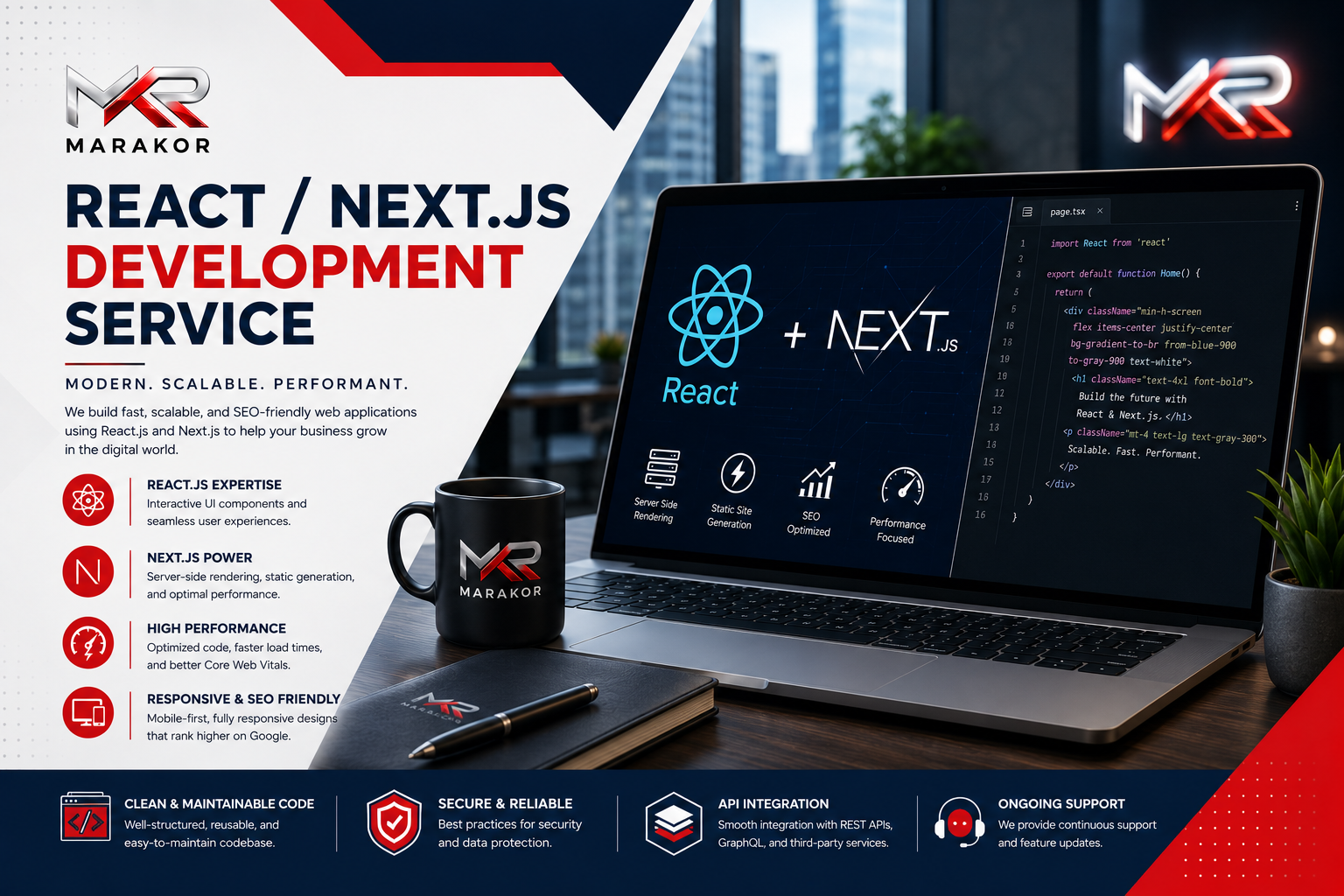
React & Next.js Development Services for Modern Digital Products
Some websites just need to present information. Others need to do things — manage users, pull data from APIs, power dashboards, or run as a full product in the browser. When a project falls into that second category, the technology stack matters more than the template.
MARAKOR builds React and Next.js applications for businesses that need more than a standard website: startups shipping their first product, SaaS companies building customer-facing platforms, and established businesses replacing outdated, hard-to-maintain frontends. Every engagement combines strategy, UX thinking, and engineering discipline — because a fast, well-built interface only creates value when it’s solving the right problem in the first place.
We don’t start from the assumption that React or Next.js is the right fit for every project. We start from the business requirement, then match the technology to it.
What Are React and Next.js?
What Is React?
React is a JavaScript library used to build interactive user interfaces. Instead of writing a page as one long block of code, React breaks an interface into reusable components — a button, a form, a navigation menu, a data table — that can be combined, reused, and updated independently.
That component-based approach is why React is a common choice for interfaces that need to respond to user actions in real time: filtering a table, updating a shopping cart, submitting a multi-step form, or refreshing a dashboard without reloading the page. React itself is focused on the interface layer — it doesn’t dictate how a project handles routing, data fetching, or server rendering, which is where frameworks built on top of it come in.
What Is Next.js?
Next.js is a React framework, meaning it’s built on top of React and adds the structure needed to take a React interface into a production-ready website or application. It provides:
- Routing — a structured way to organize pages and navigation
- Rendering options — including server-side rendering (SSR) and static site generation (SSG), so content can be generated on the server or at build time rather than only in the browser
- Data fetching patterns — for pulling in content from APIs, databases, or a CMS
- Image and asset optimization — built-in tooling to help manage image delivery
- API routes / server functionality — allowing some backend logic to live inside the same project
Not every project needs every one of these capabilities. Part of planning a Next.js project is deciding which rendering and data strategies actually fit the product — not applying all of them by default.
React vs Next.js: What’s the Difference?
This is one of the most common questions we hear from clients evaluating a development partner, so it’s worth answering directly.
| React | Next.js | |
|---|---|---|
| What it is | A UI library | A framework built on React |
| Primary focus | Building interactive interfaces | Structuring a full website/application |
| Routing | Requires additional setup or libraries | Built-in, file-based routing |
| Rendering | Client-side by default | Supports SSR, SSG, and client-side rendering |
| SEO considerations | Requires additional configuration for crawlable content | Provides more built-in support for server-rendered, crawlable pages |
| Backend capability | None on its own | Can include API routes and server-side logic |
| Best suited for | Interfaces embedded in a larger system, or highly custom setups | Full websites and applications that need routing, rendering flexibility, and structure out of the box |
Neither option is universally “better.” A React-only setup can be the right call for an interface embedded inside an existing system. Next.js tends to make sense when a project needs full site structure, SEO-relevant public pages, or a mix of static and dynamic content. The right choice depends on the product’s requirements, not a general rule.
Our React & Next.js Development Services
Performance-Focused Development
Performance is treated as part of the architecture, not an afterthought handled at the end of a project. Depending on the application, this can involve:
- Efficient component rendering and code splitting
- Image and asset optimization
- Caching strategies
- Efficient data-fetching patterns
- Reducing unnecessary JavaScript shipped to the browser
- Performance monitoring during and after development
It’s worth being direct here: actual real-world performance also depends on factors outside the codebase — hosting, third-party scripts, database response times, network conditions, and content weight. We don’t promise a perfect PageSpeed score, guaranteed Core Web Vitals numbers, or a specific load time, because those outcomes depend on more than the frontend code alone. What we do commit to is building with performance-conscious decisions at every stage.
SEO-Friendly React & Next.js Development
A properly architected React or Next.js build can absolutely support SEO — but the framework alone doesn’t guarantee rankings. When SEO matters for a project, we account for:
SEO outcomes ultimately depend on content quality, competition, technical foundations, and ongoing optimization — not the framework by itself. If SEO is a core requirement, it’s best planned alongside development from day one, not bolted on afterward. (See our SEO services for ongoing optimization work.)
Responsive Web Application Development
Every build is developed for mobile, tablet, and desktop use, with attention to:
UI/UX Integration
Strong engineering without strong UX produces an interface that works but doesn’t convert or retain users — so React/Next.js development at MARAKOR is built to work closely with design. Where included in project scope, we translate Figma files, wireframes, prototypes, and design systems into functioning interfaces that match the intended experience, not just the visual layout. This connects naturally with our UI/UX Design, Prototype Design, and Website Design services for projects that need design work alongside development.
Our React & Next.js Development Process
Understanding business goals, product requirements, target users, required features, integrations, and technical constraints before any architecture decisions are made.
Defining application structure, component breakdown, data requirements, API needs, and the appropriate rendering approach for the project.
Where included, defining user flows, wireframes, interface design, responsive layouts, and a working design system.
Building components, pages, features, API integrations, and application logic against the agreed architecture.
Checking functionality, responsiveness, cross-browser behavior, forms, navigation, API behavior, and error states.
Reviewing performance, accessibility considerations, SEO foundations, and code quality before launch.
Deploying according to the agreed hosting and infrastructure setup.
Where included in the agreement, providing post-launch maintenance and technical support. (Support scope is defined per project — we don’t offer unlimited, open-ended support by default.)
What You Receive
Depending on the agreed project scope, deliverables may include:
Exact deliverables are defined during discovery and confirmed before development begins.
React & Next.js for Different Business Types
Startups
Building MVPs and scalable product interfaces that can evolve as the product and user base grow.
SaaS Companies
Dashboards, onboarding flows, customer portals, and application interfaces built around real product workflows.
E-commerce Businesses
Custom storefronts and commerce experiences where a template-based platform doesn’t offer the flexibility the brand needs. (See Shopify Development for platform-based commerce builds.)
Enterprises
Internal platforms and complex digital applications supporting multiple teams and workflows.
Professional Services
High-performance, interactive websites and client portals that go beyond a standard brochure site.
Technology Companies
Modern product websites and application interfaces that reflect technical credibility.
Existing Businesses
Modernizing legacy interfaces or replacing outdated frontend experiences. Migrations from older systems are assessed case by case; not every legacy setup can be migrated without added complexity, and that’s evaluated during discovery rather than assumed away.
React / Next.js vs WordPress
This is a genuine “it depends” question, and we treat it that way.
| WordPress | React / Next.js | |
|---|---|---|
| Best suited for | Content-heavy sites, blogs, standard business websites, marketing sites | Custom applications, highly interactive interfaces, complex product experiences |
| Content management | Built-in, non-technical editing | Requires a connected CMS or custom admin tooling |
| Setup speed | Generally faster for standard sites | Depends on application complexity |
| Customization | Theme/plugin-based, broad ecosystem | Fully custom architecture and components |
| Ongoing editing by non-developers | Straightforward | Depends on the CMS or admin tools built into the project |
If your priority is a content-managed marketing website or blog, WordPress Development is often the more efficient and cost-effective path. If your priority is a custom application with complex interactivity or a specific architecture requirement, React/Next.js is usually the better fit. Neither is universally superior — the right answer depends on what the site or product actually needs to do.
Custom Development vs Template Solutions
Custom React/Next.js development gives you direct control over the interface, component behavior, application logic, performance decisions, and integrations — control that pre-built templates don’t offer. That control comes with a trade-off: custom development generally requires more upfront planning and development investment than a template-based build. For projects where a template or WordPress theme already meets the requirement, that’s usually the more efficient choice, and we’ll say so during discovery rather than defaulting to a custom build regardless of fit.
Why Choose MARAKOR?
Maintenance & Long-Term Support
Modern web applications aren’t a one-time build — dependencies need updates, security patches need to be applied, APIs change, and features need to evolve alongside the business. Where a project includes ongoing maintenance, that can cover dependency and security updates, bug fixes, performance monitoring, and iterative feature work. Maintenance scope is defined separately from initial development and isn’t automatically unlimited. See Website Maintenance for ongoing support options after launch.
Build Your Next Digital Product With MARAKOR
If your project needs more than a standard website — real interactivity, custom workflows, or an application your users will actually work inside of — a component-based, purpose-built frontend is worth considering.
MARAKOR combines frontend engineering, UX thinking, and performance-conscious development to build React and Next.js products shaped around your actual requirements, not a generic template.